
Are you planning your trip to El Salvador and is the decision between Carvi vs Traditional Car Rentals in El Salvador weighing on your mind? You are not alone. In a market where how we get around is changing, choosing between the digital innovation of a peer-to-peer platform and the traditional structure of a rental agency can be complex. This comparative guide has one goal: to thoroughly analyze both models so you can book with all the information at hand, save money, and experience a journey without complications. Keep reading to discover the winning option for your needs.
Renting a car in El Salvador doesn’t have to be confusing or full of hidden fees. In 2026, options like Carvi are redefining how travelers get behind the wheel — offering digital booking, transparent insurance, and fewer upfront costs compared to many traditional car rental companies. In this comparative study, we break down how Carvi’s modern approach stacks up against classic rental agencies so you can choose the best option for your needs.
Explore available cars and compare pricing with Carvi → Rent with confidence.
🚗 What is Carvi? The Peer-to-Peer Model
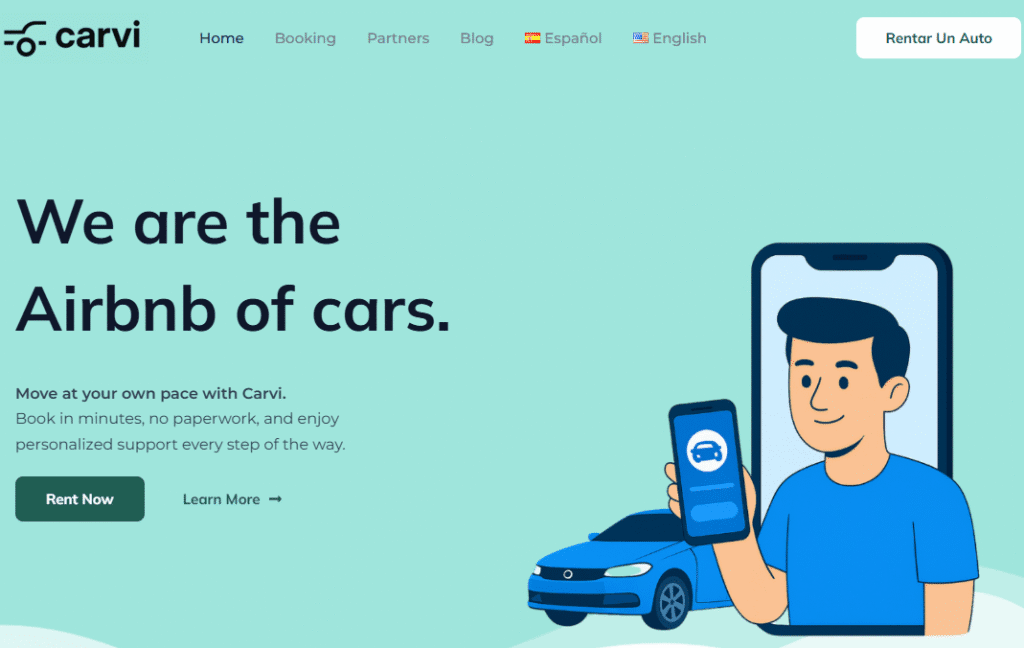
Carvi is a technology platform founded in El Salvador that operates under a peer-to-peer (P2P) model, colloquially known as the “Airbnb of cars.” Its value proposition is based on directly connecting people who need a vehicle with owners willing to rent them out, eliminating many of the procedures and costs associated with traditional agencies.
Carvi’s fundamental principle is to transform an underutilized asset, such as a car that spends most of its time parked, into a source of income for its owners, while offering users a more agile and human rental experience.
🏢 What are Traditional Car Rental Companies?
Traditional rental companies are established businesses that operate with their own vehicle fleet. Models like Budget, Europcar, Alamo, and Enterprise Rent-A-Car are major players in the Salvadoran market. These companies typically have physical offices, often located at airports and strategic areas of cities like San Salvador.
Their business model is corporate and standardized, which can involve longer processes including in-person document submission and direct purchase of insurance and additional services at the office.
⚔️ Carvi vs Traditional Car Rentals in El Salvador: Head-to-Head Analysis
Below is a breakdown of the key differences between the two models to facilitate comparison.
1. Business Model and Booking Process
- Carvi: It is a 100% digital platform. The entire process, from search and booking to payment and document management, is done through an app or website. The platform is designed for a booking to take just 3 minutes.
- Traditional Rentals: They operate primarily through a hybrid or in-person model. Although many allow online reservations, the final process of contract signing, document verification, and deposit payments often requires a visit to the office, which can extend the total time.
2. Requirements and Documentation
- Carvi: The requirements are simplified. Basically, they require a valid driver’s license and an identity document (DUI or passport), with a digital verification process.
- Traditional Rentals: They usually require more extensive documentation. In addition to the license and DUI or passport, it is common for them to request a credit card in the driver’s name to block the security deposit, and some may ask for proof of address or NIT.
3. Deposits and Guarantees
- Carvi: It advertises operations “Without DEPOSITS” or, alternatively, uses credit card guarantee authorizations that are released, representing a significant financial advantage for the user.
- Traditional Rentals: They generally require a substantial security deposit that is blocked on the customer’s credit card. This amount, which can range from $200 to $500 or more, remains immobilized until the vehicle is returned undamaged.
4. Prices and Rates
- Carvi: Offers competitive prices that vary according to the vehicle owner. The rate is usually transparent and includes basic insurance in the reservation.
- Traditional Rentals: According to KAYAK, the average rental price in El Salvador is $31 per day. Companies like Budget or Europcar may offer promotional rates from $5.80 or $7.71 per day, but it is crucial to check additional charges for insurance, GPS, child seats, etc., which can increase the final cost.
5. Insurance and Coverage
- Carvi: Includes insurance in each reservation with coverage ranging from $599 to $50,000 dollars. The user is responsible for a $500 deductible in case of an accident.
- Traditional Rentals: They offer different levels of insurance coverage, which are usually optional and at an additional cost. The deductible in case of an incident can be very high if full coverage is not purchased.
6. Selection and Types of Vehicles
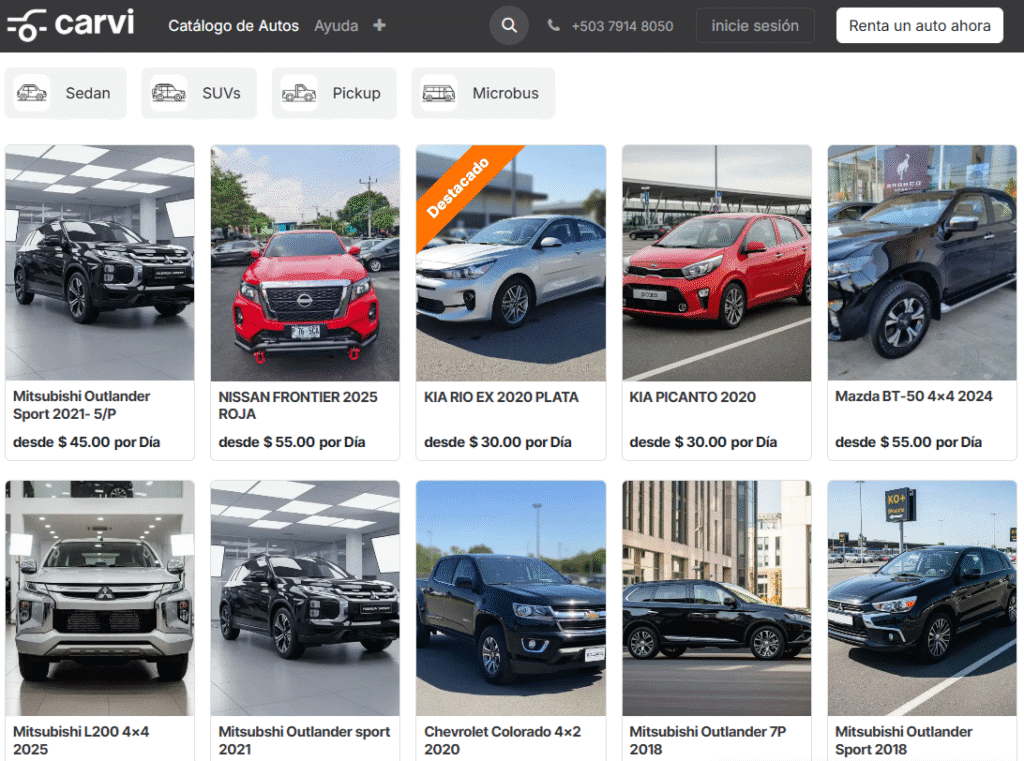
- Carvi: The fleet is diverse and depends on the vehicles that individual hosts decide to list. This can result in a more varied offering with newer models.
- Traditional Rentals: They have a standardized fleet mainly composed of vehicles of different categories (Economy, Compact, SUV, etc.). SUVs are the most popular car type in the country, with an average cost of $56 per day.
7. Flexibility and Customer Service
- Carvi: Stands out for its flexibility. Vehicle delivery and pickup are agreed upon with the host, potentially at the airport, hotel, or the user’s address, potentially at any time. Customer service is described as agile and personalized.
- Traditional Rentals: Delivery and pickup are usually limited to office locations and their operating hours. Although some offer free airport delivery, overall flexibility is lower.
📊 Comparative Table: Carvi vs. Traditional Rentals
| Category | Carvi | Traditional Rentals |
|---|---|---|
| Business Model | Digital Peer-to-Peer (P2P) Platform | Companies with own fleet and physical offices |
| Booking Process | 100% digital, ~3 minutes | Online/In-person, longer |
| Documentation | License and DUI/Passport (Digital) | License, DUI/Passport, Credit Card, other possible |
| Security Deposit | Advertises “No Deposits” | Substantial deposit with credit card |
| Average Price | Competitive, varies by host | $31/day (general average) |
| Insurance | Included ($599 to $50,000), $500 deductible | Optional, additional cost; variable deductible |
| Vehicle Selection | Diverse, from individual owners | Standardized by categories; SUV is popular |
| Flexibility | High; personalized delivery/pickup | Low; subject to office hours and locations |
Why Carvi Is Worth Considering
When comparing traditional rental companies with newer alternatives, one aspect travelers love about Carvi is simplicity:
• 100% online reservation process
• Transparent pricing with optional insurance clearly shown
• Less restrictive deposit requirements
These features give many visitors an easier and more flexible rental experience — especially if you want to avoid long counter wait times or surprise charges.
👉 Inline CTA:
See Carvi’s available cars with transparent pricing → Rent with Carvi
💡 Tips for Choosing and Future Trends
Which is the best option for you?
- Choose Carvi if:
- You prioritize a fast and 100% digital process.
- You want to avoid a high deposit that immobilizes your credit line.
- You value flexibility in vehicle delivery and pickup.
- You seek a more personalized rental experience with human treatment.
- Choose a Traditional Rental Company if:
- You prefer the security and structure of an international corporate brand.
- You have no problem providing a credit card for the deposit.
- You need additional services like GPS or child seats.
- Your flight arrives or departs during standard hours when airport offices are open.
Trends for 2026 and Beyond
The future of mobility is local, collaborative, and digital. Models like Carvi are expected to continue their expansion in the region, with plans to reach countries like Guatemala, Honduras, Costa Rica, and Colombia. For traditional rental companies, the main challenge will be to adapt their business models to offer the agility and flexibility that modern users demand.

✅ Conclusion
The final choice in the Carvi vs Traditional Car Rentals in El Salvador face-off depends entirely on your personal and travel priorities.
- Carvi establishes itself as the innovative, agile, and user-centered option, ideal for those looking to avoid bureaucratic procedures and high deposits.
- Traditional Rentals remain a valid choice for those who value the corporate structure and have no issue with established processes and requirements.
By 2026, the trend clearly points towards digitalization and the collaborative economy, a field where Carvi already has a significant advantage in the Salvadoran market. Regardless of your choice, we recommend always reading the most recent reviews and conditions before confirming any reservation.
In this comparison, both traditional companies and Carvi have strengths — but if speed, transparency, and ease of booking matter most to you, Carvi is a compelling modern alternative. With online reservations, clear pricing, and insurance shown before you book, many travelers find Carvi easier and more predictable than classic rental agencies.
🚘 Ready to simplify your car rental in El Salvador?
Explore available cars with Carvi and book your next ride with confidence.
Share this content:













Post Comment